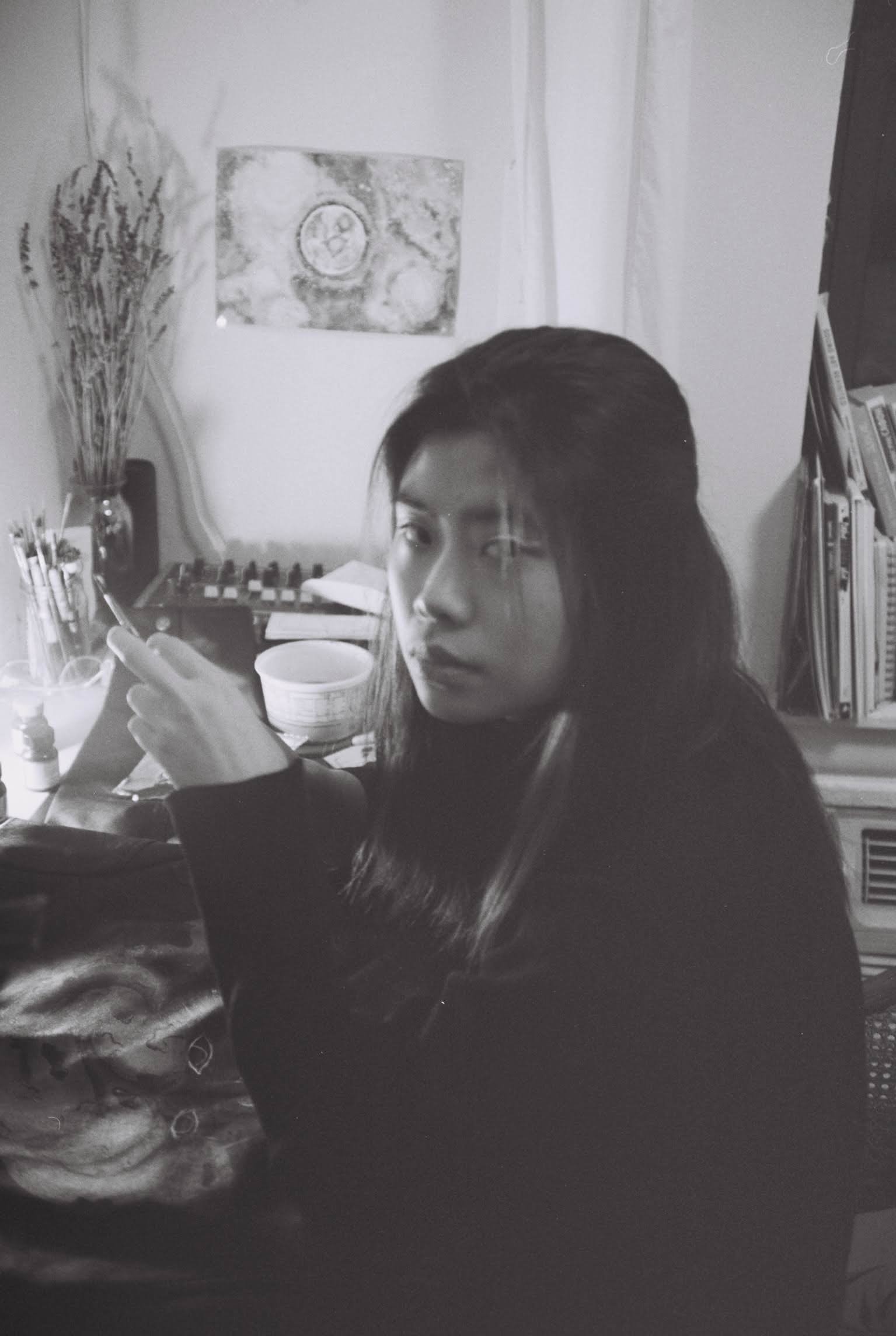
Paris, 21h. 07 avril 2025.
Dans un monde où la technologie et l’art se mêlent de plus en plus, où les frontières entre le physique et le numérique s’estompent, la musique expérimentale devient un terrain d’exploration infinie.
Anya Tran, musicienne et artiste visuelle, incarne cette quête d’expression libérée des conventions. Née au Vietnam, élevée en Russie, puis installée à Brooklyn, elle a troqué le piano classique pour le theremin, un instrument envoûtant, pour s’affranchir des règles rigides de sa formation musicale.
Amar Adjona, artiste et intervieweur passionné par les liens entre spiritualité et création, la rencontre après un de ses performances à Paris. Leur conversation, fluide et profonde, traverse les thèmes de l’identité culturelle, de l’improvisation comme langage artistique, et de la recherche d’une spiritualité en dehors des cadres traditionnels.
Entre rires et réflexions, ils échangent sur la scène DIY de New York, l’influence de Moscou et du Vietnam dans le travail d’Anya, et la manière dont l’art peut devenir une expérience presque mystique où le public et l’interprète se retrouvent liés par quelque chose d’indicible.
Amar : Hello Hello!
Anya : Hello
Amar : do you speak a bit of French?
Anya : So, no, just… just trying.
Amar : Yes… haha. What time is it in New York?
Anya : it’s like 3 P.M. right now.
Amar : So, how… , what do you do? Are you working or studying?
Anya : Yeah, I work. I have a day job. And what about you?
Amar : same, same, just like you. I… uh, so I have like a job, I work for a software company haha
I do music and photography. That’s what I really enjoy. I was at Mesmerize and then when I saw you, like, doing the theremin stuff, I was like “okay! I have to talk to her”. I really enjoy talking to artists and trying to see why they are doing what they’re doing. So… from the start, uh, were you born in New York?
Anya : No, so it’s a very complicated story, but I was born in Vietnam.
Okay, before I was born, my parents moved to Russia. It just happened that I was born in Vietnam, and then when I was three months old, they brought me back to Russia. So I grew up in Russia.
Amar : Okay
Anya : Yeah. I would say my first language is… well, I’m bilingual. But I’m mostly fluent in Russian, I’d say.
Amar : So, you… you lived your whole life—uh, no, like most of your life in Russia?
Anya : Yeah, I moved to America for university.
Amar : Okay. how long ago?
Anya : Twelve years ago.
Amar : Hmm, okay. And you miss Russia, or—?
Anya : Yeah, I mean, for me… at the end of the day, Moscow is still my home. That’s the place I have the most, like… memories. So yeah, I have a lot of memories from there, since childhood. So.
Amar : Okay, then… in my question I was wondering if there’s like an influence of Vietnam in your music. But it must be more Russia than Vietnam?
Anya : Yeah, I mean… it’s a very interesting question because I feel like… for the longest time, I tried to find my own identity. As an individual, but also artistically.
I was classically trained in Russia, so I had a very strong, very typical, very strict Russian music education. But I feel like—well, I don’t know if you noticed my performance—but actually I kind of sang, and I read a poem in Vietnamese.
Amar : No, I didn’t recognize the language haha
Anya : (laugh) I did that on purpose. It was actually my first time singing. But I chose Vietnamese because… I was thinking of a language that people would probably understand the least.
Because, I know, there are a lot of Russian-speaking people in France, and I keep hearing Russian on the street in Paris all the time. So I was trying to keep my identity… hidden, in a way. As much as I can.
But I think that’s the route where I want to go—in the sense of maybe adding bits of Vietnamese influence, either through lyrics or sampling instruments. For example, I really like the sound of some traditional Vietnamese instruments. And I sampled them, actually, during the performance.
So it’s just like a little bit here and there. That’s where the Vietnamese influence comes in. But I would say, overall, the genre is still more experimental.
Amar : Okay, but this is—like—you’re saying that this approach is very new? You started… that was the first time? Or is it something you’ve wanted to do for a long time—the Vietnamese influence?
Anya : Well, for music, it’s definitely new. Because I also program visuals, and I’ve done visual work before using Vietnamese instruments in the past.
But with sound, this is the first time. Before that, I used to play more… not generic, but just experimental music. Because my background is classical but I really wanted to get out of that. And it was hard for me to escape it—until I started playing the theremin.
Amar : What do you mean?
Anya : I feel like… if I don’t play classical music the right way, then… it just doesn’t feel right. It’s like muscle memory for me. I couldn’t escape it.
Amar : Oh! So it’s almost the opposite?
Anya : Yes, exactly. When I started learning the theremin, it helped me to get out of that mindset. And now I’m continuing on that journey—trying to get as far as I can from my classical background. So right now, I want to explore more: what are some Vietnamese influences I can add into my work.
Amar : Did you stop classical piano completely?
Anya : Yeah, I mean, I graduated from music school before moving to the U.S. And since then—I still play. I have a keyboard at home, and sometimes when I’m bored I play classical pieces for myself. But I don’t perform classical music anymore.
Amar : Okay. And… wait, so how long have you been in Brooklyn. Why Brooklyn?
Anya : Yeah. Before moving to New York, I lived in Boston and a bit in California. At the time, I felt a bit lost. Boston was good, but boring. California was too slow for me.
I wanted that energy, the craziness. I was also much younger back then. So I moved to New York.
Amar : You mean it’s faster in Brooklyn than California ?
Anya : Oh yeah, for sure. I lived in San Francisco for a year and a half. Then I moved to New York. Coming from Moscow, which is huge and fast-paced, I wanted something similar. A place where a lot of things are going on.
So that was the first reason why I moved to New York.
And yeah, I’ve been living in Brooklyn the whole time. It’s more affordable than Manhattan.
Amar : Okay, because I’ve been to Los Angeles and… I really didn’t like it. But I don’t think it’s for the same reason. To me, it’s like… you have to do everything by car.
But I feel like that’s an American thing?
Anya : That’s why I left California! I hated being dependent on cars.
And New York is probably one of the only cities in the U.S. where you don’t need a car to live.
Amar : Yeah, they say—don’t know if it’s true—but they say New York is like a European city.
Anya : I mean, it’s similar, yeah. In the way you live. People don’t have cars, the culture is different. Like, you go to get groceries every day—you don’t do those massive once-a-month grocery trips.
Amar : Yeah, in Paris, you’re always walking.
Anya : I asked my American friends, to walk with me, and they’re like, “No, we don’t.” It was crazy.
Amar : When I was in Los Angeles, I’d be at my place, I’d look at Google Maps, and see another place that’s not far, and I’d think, “Okay, I can just walk there.” That’s how you’d do it in France, right?
So I go out… and it’s like, a no man’s land. There’s just nothing between here and there. Just, like, emptiness, and then the place you wanted to go to.
Anya : Yeah, it’s very much so… .
Amar : have you lived in Europe?
Anya : I mean, I guess Moscow is Europe, right? Or not really? (laugh)
Amar : (laugh)
Anya : Yeah, I guess technically, Moscow is Europe, right? But otherwise, no, I haven’t lived in Europe. I’ve just been there a couple of times. I think at the end of the day, culturally, I feel the most comfortable in Europe—lifestyle-wise, and I just understand it better. Again, like, Moscow is technically in Europe, I guess.
Amar : what about Asia?
Anya : I go to Asia occasionally because my extended family is in Vietnam, but I wouldn’t say it feels like home.
Amar : Got it. Do you have family in Brooklyn?
Anya : No. My family is in Russia and Vietnam.
Amar : Okay. So, what made you transition from classical piano to the theremin?
Anya : Honestly, it was totally random. It was one of those pandemic hobbies.
One of my close friends and I were joking around, and I told her she had to learn the theremin. So she actually bought one and started learning it.
Then I borrowed it from her, played around, and I really liked it—so I got my own. That’s how it started.
And as I said earlier, it felt really liberating. There’s no standard way of playing the theremin, so I got to learn it however I thought felt right.
There’s also not that many people who play it, so I wasn’t comparing myself to others. I ended up developing my own approach.
Amar : Yeah, it snowballed from there?
Anya : Exactly. I kept exploring the instrument and its possibilities. And I’m still developing it.
Amar : I read that people say the connection with the theremin is very tactile—but in a different way than, say, piano. How is it different?
Anya : Yeah, it’s really different. With piano, when you press a note, you see it—you know exactly what it is.
But with the theremin, it’s like… you can’t really see it. You have to rely on your ear to find the pitch. That was the hardest part for me.
And in terms of volume and pitch—when I move my body even slightly, it picks that up and alters the sound.
So, in a way, it feels like I’m touching the sound itself, which makes it very direct. The piano is less sensitive, for sure.
Amar : Yeah, because on piano, you press the key and the note you want ?
Anya : Exactly. With theremin, the slightest movement changes everything.
Amar : Okay.
I feel like your performances are always improvised. Is that true? Or is there a structure?
Anya : I’d say it’s half-prepared, half-improvised.
When I improvise, it’s not just randomly messing around—I improvise within a musical context. It still has structure.
Especially when I perform with someone else, and we’re jamming—it’s live interaction, and that’s beautiful.
You can feel the chemistry in the room.
Amar : And the audience? Do you consider them while playing? Is there a connection?
Anya : I do look at the crowd—to read the room a bit.
But mostly, I want to guide people through a journey. It’s a bit spiritual, honestly.
Amar : Yeah, I felt that.
And do you participate in creating the scenography? Like in Paris, was that your projection?
Anya : No, that was Gabriel’s projection.
Amar : Ah okay. Did it match your music?
Anya : Yeah, totally. I really liked the setup in Paris. But honestly, the only thing I need is just outlets and speakers—for my setup and my laptop.
Amar : Can you play in any environment, or it must be like the one we were?
Anya : I mean, for me, like the only thing I need, like, my setups and the light. Really enjoyed the fact that… , it felt very DIY. And I’ve heard from… from other people that might say like, I think in Paris, you guys usually don’t have this kind of events. I might be wrong, but I don’t know… this kind of… this kind of word. Like, DIY, yeah
Amar : like more underground, spontaneous?
Anya : exactly. Because, uh, this is like the kind of, like, I guess, the kind of events I usually play in New York, like… kind of low production, like people just bring whatever they have.
Amar : ah, okay.
Anya : I mean, I played at, like, proper venues, maybe like a couple of times, but that’s definitely not the place I really like to play because I feel like it’s too, like… academic or something, like too proper.
Amar : Oh it’s good. Now we need more of this in Paris. But it… it felt really, uh… like Berlin.
Anya : D-I-Y. Do It Yourself.
Amar : yes and since, uh, this instrument is… it’s old. Because, it looks like a futuristic thing, but actually, it’s very old. Like, do you… is there like still room to develop new techniques ?
Anya : I mean, if anything, I think there is a lot of room to explore this instrument, because actually—because since not so many people play it, right? Like I feel like not all… people haven’t explored this instrument… a lot, you know?
I really, like, I have like a couple of…, guitar pedals, like guitar rack effects, with the theremin. I would route it for them to have an electro effect. And then I also have a looper. So I can basically like layer, like, live multiple theremin sounds at the same time, basically. I mean, I haven’t seen anyone playing like that… not that much.
Amar : And do you record, or it’s just performance?
Anya : so right now… I actually started. Because I… I want to have something more than just like a live performance, right? And… I think that’s going to be my next goal. With my music.
Amar : Like make an album or something?
Anya : Yeah, like I want to… to record.
Amar : Is it possible to mix with visuals? Like to be able to modulate visuals the same way you modulate sound with the theremin?
Anya : So technically, yes. There are multiple ways you can do that. Um, you can either just like… make your visuals take the output, the sound of the theremin. And then you can just map the sound to visuals somehow—just like one way. The second way, you can use the theremin with like some MIDI outputs.
Amar : Ah yeah, like digital mapping?
Anya : Yeah! Because like, MIDI output—and since it’s MIDI, you can more precisely, map the numbers, coordinating X and Y coordinates with your hand. And you can map it in your visuals as well.
For visuals, I mean, I personally use TouchDesigner.
I would say the second way—where you connect and map the MIDI output—it’s not really intuitive. Like, I think there are better ways to approach… if you want to do like hand-motion tracking, I think there’s some better ways than using the Theremin. But I mean, it’s definitely doable.
Amar : Okay. Is it something that interests you, or you’re just into sound?
Anya : I really like visuals. I actually… I started doing visuals before I started playing Theremin. And I do consider myself a very visual person, for sure.
But I feel like when I started playing theremin, I put my visual stuff on pause a little bit. Because it was very hard for me to handle both of them at the same time.
Amar : When you say visuals, like, what do you mean?
Anya : Like more, I guess, generative art? Or video art? Like installations. For example, I did a setup—it was like a movie setup stage, an installation, kind of visuals. I also did live visuals for my friends’ performances. I was actually doing visuals live while they were playing live. That kind of stuff.
And I think my dream would be to do like an audiovisual performance by myself. But I feel like I need an extra two hands for that! (laugh)
Amar : Create a whole atmosphere.
Anya : Yeah.
Amar : It would be very nice.
Anya : Yes.
Amar: That’s why I asked if you’ve ever worked on scenography—because when I listened to your music, the red lights, the smoke, the dark atmosphere… it all felt like part of the experience. Like, the environment was just as important as the sound in creating the emotion.
So my question is: do you consciously control all of that? Do you know exactly what you’re doing—every sound, every plugin, every light?
Or do you prefer to leave room for improvisation, not fully mastering everything, so that the emotion comes from that spontaneity and unpredictability?
Anya : Yeah, I see. I mean, I think that—I mean, this is my approach when I say like “improvisation.” it’s still within a pre-constrained context. it’s not like I’m free to go wherever I kind of want.
I think that—again, I guess because of my classical background—I have like the classical ear already, which helped me a lot when I play. Like, I guess when I play music, it’s not just like I’m playing random notes. But it’s like—I guess I try to make it sound harmonious, you know?
I don’t know if you have seen like jazz improvisation?
Amar : Yeah.
Anya : So technically they are just improvising it live, right? But it’s still within the jazz context, you know what I mean? Like still within the boundaries—it makes sense in the jazz context.
and the same with me. Like… it’s like improvised, but… I would say not like—I don’t really—it’s like… I mean, I don’t really know how other people play, but I still… for me improvisation—I mean, the correct definition of my way of improvisation is that… you have to like master something pretty well already, and you kind of know your tools.
And now, like, with the existing tools that you have in your hands, you are free to do whatever you want, with how you know the power of it. Just like piano. Just like a classical piano.
Amar : Yes, because it’s like when you see… like—I don’t know how to say it in English but… virtuosité.
Anya : Ah yeah.
Amar : So when you see that, and you don’t know, like, you’re not into music or piano or whatever, you feel like the person, the artist, is just—I mean, he doesn’t control anything. It’s… uh…
Anya : Yeah.
Amar : But actually it comes from what you say. Like… already mastering, and then playing into the frame.
Anya : Yeah! Like you are comfortable with the tools that you work with.
Amar : And so, um… talking about tools—are you always searching for new softwares and tools? Or do you already have everything, and then you’re not looking for new stuff?
Anya : It’s actually very, very interesting question. Because, like—it’s like I’m trying to keep my balance between, like, mastering what I have right now versus like… continue like always chasing after the new stuff.
It’s very tempting. But like—I did spend a lot of time when I was a bit younger just chasing after the new stuff. And then like… I end up nowhere.
I would say like with music, I think I’m more… I’m pretty happy with my current setup. I like the fact it’s—it’s enough for me to, like—I still can explore things without like needing to buy or like, I guess, invest in new tools, new piece of equipment.
No, I kind of wanted to master what I have right now first. I always still, like, find new combinations of like how like different tools could interact with each other to make a new sound.
In terms of like visuals, I feel like I’m a bit different, because I feel like I’m a bit more experimental with videos. I think… next visual project, I want to do something with like AI visuals.
Amar : Like what? What do you mean, like, what are you going to use?
Anya : I mean, my perspective towards AI, especially in art. I mean, I personally see it just like another tool. Like Photoshop, or like TouchDesigner, you know?
Just another technology that—like, if you know how to use it correctly, then like, something interesting will come out.
Because the thing—the problem with AI is… I feel like people don’t apply it correctly. That’s why you see like, a bunch of generated AI-looking photos, and people say, “Oh, it’s like stealing another artist’s style,” like plagiarizing and stuff.
Amar : do you mean they—they make it seem that they created something, but they used AI? That’s what you’re saying?
Anya : In a sense, like—I think they put too much reliance on AI. And because of that, it… creates less originality. And the way I see AI is more like—it’s like your assistant.
I think at the end of the day, if you use it correctly, it will still be like… your touch, like your vision. It has your style on there. But like, yeah—it just like… helps you to make your vision come true.
But that’s where, like… the artist’s responsibility is, like—to find that spot where like, it’s still you. And AI doesn’t like overpower your work to the point you don’t recognize your work anymore.
Amar : Hmm, yeah. Yes, I agree. This is also how I feel about AI in general.
Because everyone is like, scared. But if you’re scared, it means that—when it comes to art, I’m saying—it means you didn’t understand what art is.
It’s not about having the technical skill to create something. It’s about you, as a human, expressing something and sharing it with other humans. That’s the core of it.
Anya : Yeah
Amar : It’s like saying, “I can talk to ChatGPT at 2 a.m., it gives great answers, so… friendship is dead.”
Just because this AI is helpful and responsive doesn’t mean it can replace real human connection.
And to me, it’s the same with art—no tool can replace the human behind the expression.
So I like that you feel the same way. That mindset can help you push beyond your limits and really develop your own direction.
But I’m curious—when it comes to visuals, how do you approach it? Do you write prompts? Do you use tools like Stable Diffusion? Are you building your own visual style? How do you see that part evolving?
Anya : I don’t use Stable Diffusion. I use this tool called ComfyUI.
It’s very similar to TouchDesigner in aesthetics, node-based. You can do either like text-to-image or like image-to-image and I think that still, like, at the end of the day, the inputs are mostly going to be my original content.
Maybe like—I don’t know, the photos, the little—the drawings that I make, you know?
Like, I’m creating my own stuff, and… I’m kind of using AI to assist me, to add more layers, right? On top of my work. So yeah, I use ComfyUI.
I also… um, I want to look into more like—how to make video-AI useful. But I haven’t really explored much of that. Because I do have like… I want to see if I can do like… AI videos.
But I don’t know if my computer will be handling. (laugh)
Amar : Yeah… haha
Anya : Well, that’s like one of my aspirations. Like, that’s what I want to try next.
Amar : Alright, cool. Do you have to go soon ?
Anya : well I technically have to go in like… 20 minutes.
Amar : Okay. So like—the question that I wanted to ask you before, but I forgot, is—like… Brooklyn. Do you also like the city for the connection? The artistic connection? Or not?
Anya : I find Brooklyn is a very interesting place to be—as an artist. and well, I guess New York in general. Because I feel like everyone—not everyone—but like a lot of people want to come here, like to do stuff here, you know?
Like I feel like it does attract a lot of very… a lot of aspiration, or big—I guess “big dreams” if you say so. It always feels like people are doing something really cool around you.
You can get a lot of inspiration from that, for sure.
And I think another thing that’s really cool about New York is that—it’s such a melting pot that, like…I feel like—it’s barely—you can’t say there’s only one genre, or like this thing that is dominating in the city. Because I feel like the city has a little bit of everything.
And… you can see it’s very open-minded for experimentation. It’s like, if you show up, you can just play something very random. People are very doubtful, I think. But people also are very—they like novelty as well. I think that’s like—if I have to define one quality of people in New York—it’s like, they always chase the new things.
Which could be a good thing, but also a bad thing.
But I think like in terms of art, it’s very exciting.
Because sometimes you go to a show—you don’t really know what to expect.
It could be like… very bad. Or it could be mind-blowing.
That’s how the experiment goes, you know?
Amar : Okay, trop cool. And you have—you connect often with the artists in the same genre as you? Or you are one of the only one
Anya :
No, I would say like… I have friends from like all different industries. Yeah, I think like my highlight of like… I guess getting into arts in New York—during the pandemic—I moved house or apartment. I was living in an artist studio, actually.
With a couple—well, I was just renting a room in their apartment.
And the living room was basically… um… And they—they were much older than me. They were like in their 50s basically.
And like, the husband is a sculptor.
And his wife is like in theater.
But she also does a lot of things at the same time.
And I feel like… living with them—it was a very eye-opening experience.
Because they kind of showed me how our industry actually works.
Uh, and… what is actually the behind the scenes.
After, like, I moved out from the apartment, and I felt like… they gave me that initial spark for me to continue.
And like, also leaving them—yeah, I started making more friends in like different industries.
Amar : Wow nice.… I have two—two questions left.
So the first one is: if I had to describe the essence of your work in one word… what would it be?
Anya : (laugh) yeah. I remember the question. I was thinking about this a lot.
Can we—can we ask, can we do the second question first?
Amar : Sure. The second question is… I think it’s… you don’t have to answer it, because some—it’s maybe—It’s something I always ask but sometimes people don’t… don’t understand it or so. Let me ask—let me say it, and then you can. So the question is:
Is it possible for spirituality to exist within a profane context?
What I mean is: can we find a form of spirituality that isn’t tied to religion?
I ask because, in France, religion has been largely absent from public life for a long time. But people obviously still crave something deeper—meaningful connection, a sense of purpose.
At the same time, capitalism isn’t fulfilling that need. Most people hate their jobs, feel disconnected.. again obviously. So as a society, we’re searching for something more.
That need for meaning can sometimes be found in events—like the one where you performed.And in that space, as an artist, you almost become like a kind of preacher… or spiritual guide, in a way.
Do you see yourself that way?
Anya: Um, I mean, I was joking with my friends, right?
I don’t really listen to it anymore, but back then we used to say, like, « techno is our religion. » Like, going out was kind of like our Sunday church, you know?
Amar: yes
Anya: Yeah, but, I mean… I don’t consider myself religious, but I do think of myself as spiritual in a way. I don’t really connect spirituality with religion, specifically. For me, at least when I play music, it’s something really personal.
I remember once, I was playing in London with two other musicians—two guys. I was on piano, another was on a electric guitar, and the last on the violon, we were kind of jamming live, improvising. And during the set, I looked at the crowd here and there, and I started seeing people crying.
At first, I kind of freaked out, like, “What’s going on?” But I kept playing, you know? I couldn’t stop. And I guess it just hit me that maybe what we were doing really touched them—like, on a soul level.
So, yeah, to go back to your question, I do think music—what some people are doing out there—can definitely be a spiritual experience. It can be meditative, depending on what kind of music and how you engage with it. Like, if you’re really listening, deeply focused, you’re in a kind of flow. You’re just following the sound somewhere.
Amar: Yeah, yeah. No, that was a really good answer.
Because honestly, I’m always a bit nervous when I ask this question—it can seem kind of out there, you know? Like a bit too abstract or even weird. But the way you answered shows that for you it’s real, and that’s great.
So… did you ever find a word for my first question ?
Anya: (laughs) Not really. I mean, it’s hard, right? One word feels way too limiting. Like, it only captures a tiny fraction of the whole thing.
Amar: Yeah, I get it. Sometimes artists have that one word ready, because they’ve thought about it and they want to make people feel a specific thing. But with your approach—since you’re more into experimentation—it makes sense that a single word doesn’t do it justice.
Anya: Exactly. It’s like… if you see my path as a journey. I’m a bit out of focus, kind of all over the place, but that’s just how I am. Even outside of art, that’s part of my personality—I like doing a lot of things here and there.
Amar: And how do you feel right now in terms of where you’re going? Like, earlier you talked about moving around, starting with classical music, now doing something that feels almost opposite. You’re in Brooklyn now, into electronic stuff… Do you feel like you’ve found your path? Or do you think you might switch again in a couple years?
Anya: Good question. If you’d asked me, like, seven or ten years ago, I think I was a lot more ambiguous. But over time, I feel like I’ve been narrowing things down—like, not to a specific goal or job, but more like… a direction.
I still don’t know exactly what I’m walking toward, but I feel like I’m on the right path. It’s like I’m walking through fog, but there’s a kind of intuition telling me I’m going the right way—even if I can’t see what’s at the end yet.
Amar: Yeah, that makes sense.
Anya: Like, when I look back at my childhood, or even just a few years ago—everything kind of adds up. The things I was into, the skills I’ve picked up… it all makes sense now.
I didn’t really aim to be here; it just kind of unfolded this way. I trust the process more than I try to force a destination, and I guess that’s what brought me here.
Amar: Totally. I could honestly talk to you for hours, but I know you have to go. This was super interesting. I love doing these interviews.
Anya: Yeah, this was actually my first time doing a conversation like this—this long, this in-depth. It was weird in a good way, haha.
Amar: (laughs) Are you planning to come back to Paris at some point?
Anya: No plans right now. If anything, I might head to Berlin. I’ve got a lot of friends there, and maybe I’ll find something—maybe even get to perform. But yeah, nothing confirmed.
Amar: Cool. Thanks again, really—it was such a great chat. I’ll keep an eye on your next projects!
Anya: Definitely, and I’d actually love to ask you a few questions too—if I had more time. I’ve only seen one of your interviews so far, and I’m curious. What’s your whole project about?
Amar: Oh yeah—so, you know the question I asked you about spirituality and profanity? That’s actually the core of my work.Everything I do—music, photography, writing—it all revolves around that reflection. I really believe in human connection, and I try to create as many real moments as I can.
And every time I meet someone like you, “je me sens augmenté” don’t know how to say it in english. I become more knowledgeable, more aware, even happier. That’s why I do what I do. My photography tries to capture that spirit—something almost invisible. And I talk to as many artists as I can because I feel like you’re the ones who get it. Or at least, some of you go deep enough to connect with what I’m trying to explore.
Anya: Wow, yeah. That really makes sense. I wish I could ask you more right now!
Amar: Let’s do a part two sometime haha , when you’ve got time.
Anya: Yeah, for sure. Let’s set it up soon.
Amar: Cool. I’ll text you all the details. I’ll send over the interview too—so you can check, change stuff, whatever you want before it’s published.
Anya: Sounds good.
Amar: Alright, have a good day!
Anya: You too! Bye!